
Thiruvananthapuram | 1 October 2026: A poem by Kerala-based poet and writer Shajil Anthru, The Perfect Wound, has found another international literary platform with its presentation as a video poem on the Italian literary blog L’Age d’Or – Bardamu.
The Italian feature, titled “Una videopoesia di Shajil Anthru” (“A video poem by Shajil Anthru”), presents a contemporary poem rooted in Kerala’s cultural imagination to an Italian literary audience.
The significance of the publication lies not merely in the geographical distance between Kerala and Italy, but in the fact that a poem emerging from Kerala’s mythology and cultural memory has entered an Italian literary space while retaining its distinctive identity.
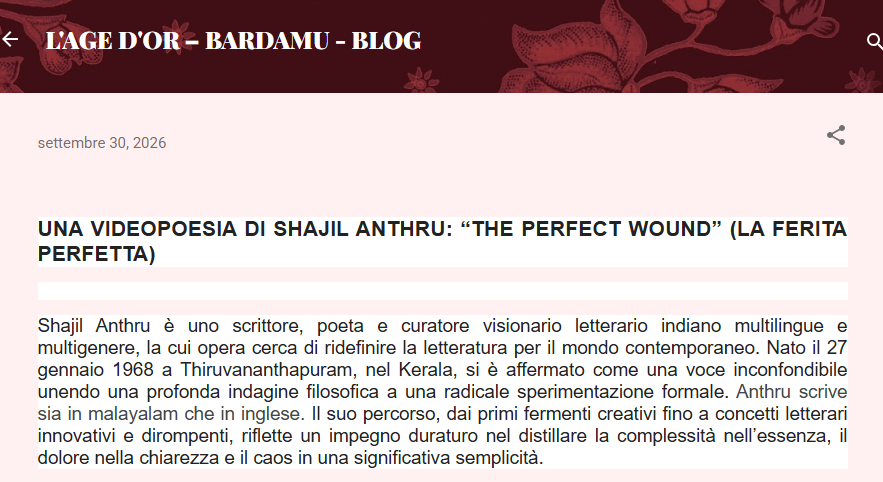
Read the Italian feature:
L’Age d’Or – Bardamu: “Una videopoesia di Shajil Anthru”
L’Age d’Or – Bardamu: An Italian literary and cultural space
L’Age d’Or is an Italian online magazine and cultural-literary platform covering cinema, literature, poetry, theatre, art and contemporary culture. Its published masthead identifies Marco Palladini as Direttore Responsabile (Director) and Désirée Massaroni as Direttore Editoriale (Editorial Director).
Marco Palladini is himself a writer, poet, playwright and cultural commentator whose writings appear extensively through L’Age d’Or. His contributions to the platform include poetry, literary reflections, theatre and cultural criticism.
The literary character of the publication is evident from its range of material, which includes poetry, literature, contemporary art, theatre, cinema, critical essays and cultural commentary. Its archive includes writings by Palladini as well as contributions by numerous other Italian writers and cultural figures.
It is within this Italian literary and cultural environment that The Perfect Wound has appeared.
For a poem originating in Kerala, this represents an interesting instance of literary circulation across cultures.
From Mahabali to an international readership
The Perfect Wound takes one of Kerala’s most enduring cultural figures—Mahabali—and places him in an unusual poetic landscape.
The poem is constructed around Mahabali’s return from the Netherworld during Onam. Instead of presenting Onam only through its familiar associations with celebration, prosperity and the return of a benevolent king, the poem opens a more contemplative space involving memory, justice, exile, return and unresolved loss.
Mahabali addresses an unnamed “you”. The identity of this addressee remains open, allowing the poem to move beyond a straightforward retelling of mythology.
At the centre of the poem stands its defining image: the “perfect wound.”
The wound is not merely an image of suffering. It becomes a larger philosophical question: can remembrance, ritual and celebration compensate for an unresolved wound created by exile, separation and loss?
A critical study of the poem, Mythic Descent and the Ethics of Remembrance: A Critical Reading of “The Perfect Wound”, published in September 2026, examines the poem’s treatment of Onam, Mahabali, descent, memory and justice. The study also reads the three-fold descent in relation to the three steps of Vamana.
When a Kerala myth becomes a universal question
One of the most interesting aspects of The Perfect Wound is that it does not attempt to become “international” by abandoning its Kerala identity.
It does almost the opposite.
It begins with a specifically Kerala cultural memory and raises questions that can be understood far beyond Kerala:
What does it mean to remember?
What does return mean after exile?
Can celebration erase historical pain?
Can time heal the wound of separation?
What remains when memory becomes ritual?
These questions allow the poem to move from the local towards the universal.
The cultural vocabulary belongs to Kerala, but the emotional and philosophical questions belong to human experience.
Mahabali remains Mahabali. Onam remains Onam. Kerala remains present.
Yet exile, remembrance, waiting, loss and return are experiences that do not belong exclusively to any one culture.
This is one of the ways literature travels across borders. A poem does not necessarily become universal by removing its cultural particularity. Sometimes it becomes universal precisely because it speaks from the distinctive experience of a particular place.
From the printed page to visual poetry
The Perfect Wound has also developed beyond the printed page.
Litterateur TV released a visualised reading of the poem under the title Shajil Anthru’s Poetry – The Perfect Wound Visualization. The video presents the poem through a visual interpretation of Mahabali’s voice, descent, memory and unanswered questions.
Watch the visualised poem
Watch “The Perfect Wound” on YouTube
The poem has consequently existed in several forms—as an English literary poem, as visual poetry and as the subject of critical interpretation.
The Italian presentation adds another dimension: international digital literary circulation.
A poem written in India, rooted in Kerala mythology, transformed into visual poetry and subsequently presented through an Italian literary platform demonstrates how contemporary digital culture can create connections between writers and readers separated by geography, language and cultural history.
A poem that invites critical reading
The international appearance of The Perfect Wound comes at a time when the poem has also begun to attract critical attention.
The September 2026 issue of the International Research Journal of Modernization in Engineering Technology and Science (IRJMETS) carries the study “Mythic Descent and the Ethics of Remembrance: A Critical Reading of ‘The Perfect Wound’.”
The study examines the poem’s treatment of Onam, Mahabali, descent, memory and justice, placing the work within a wider literary and comparative framework.
Thus, The Perfect Wound is beginning to occupy several literary spaces simultaneously: poetry, visual expression, critical interpretation and international digital publication.
Why this matters for Kerala literature
For Kerala’s literary community, the Italian appearance is a reminder that international literary circulation is no longer dependent exclusively on conventional publishing houses and printed journals.
Digital literary platforms, independent cultural blogs, online magazines, video poetry and international literary networks have created new pathways through which writing from regional cultures can reach readers elsewhere.
A poem can begin with a local myth, move through an international language, acquire a visual form and eventually appear on a literary platform in another country.
The journey of The Perfect Wound demonstrates precisely such a movement.
It begins with Onam and Mahabali.
It emerges from the cultural memory of Kerala.
It is written in English by a Kerala poet.
It becomes visual poetry.
It becomes the subject of a critical literary study.
And it subsequently appears on an Italian literary platform.
The geographical distance between Kerala and Italy becomes less significant when a poem succeeds in creating a point of human connection.
Shajil Anthru and the international literary conversation
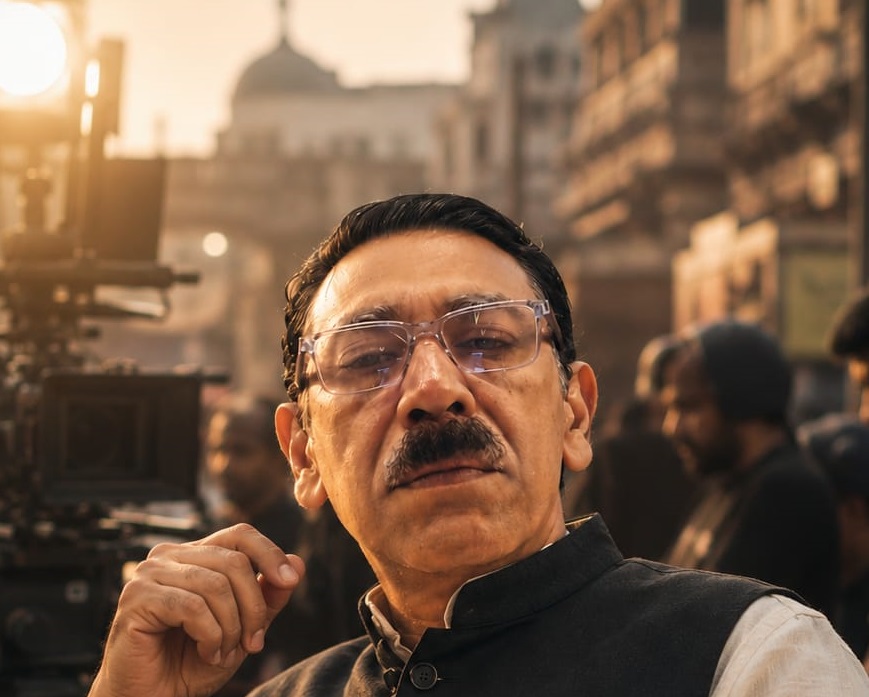
For Shajil Anthru, the Italian appearance adds another dimension to a literary career that has developed across poetry, fiction, criticism, editing and cultural publishing.
Anthru writes in Malayalam and English and is the Founder and Chief Editor of Litterateur Redefining World. His literary and editorial work has focused on bringing different literary cultures, writers and perspectives into conversation.
The appearance of The Perfect Wound in Italy reflects that wider literary movement.
The poem does not travel as an abstract piece of writing detached from its origin. It travels carrying with it Mahabali, Onam, Kerala and the memory of a culture, while simultaneously asking questions that can be encountered by readers elsewhere.
From Kerala to Italy—and beyond
There is a larger significance to such literary encounters.
Kerala has a long and rich literary tradition, but the international circulation of contemporary Kerala writing has often depended upon translation, individual literary initiatives and networks outside the conventional literary establishment.
The digital age is opening additional pathways.
A poem can cross a national boundary almost immediately. A visual interpretation can reach another continent. An independent literary platform can introduce a writer from a distant culture to a new readership.
The appearance of The Perfect Wound on L’Age d’Or – Bardamu is one such moment.
The poem began in the imaginative world of Mahabali’s return. Its movement into an Italian literary space creates another kind of return: a Kerala voice reaching a wider literary world through contemporary digital culture.
Perhaps that is ultimately what makes the journey of The Perfect Wound worth noticing.
A poem does not cease to belong to Kerala when it crosses the border. It carries Kerala with it.
And when Mahabali’s voice is encountered in another literary culture, the wound at the centre of the poem can become not merely a symbol of exile, but also a point of connection between different worlds.
From Kerala to Italy, The Perfect Wound continues its journey.
Related Links
Italian feature:
L’Age d’Or – Bardamu: “Una videopoesia di Shajil Anthru”
YouTube – The Perfect Wound:
Shajil Anthru’s Poetry – The Perfect Wound Visualization
Critical study:
Mythic Descent and the Ethics of Remembrance: A Critical Reading of “The Perfect Wound”
The Onam celebrations in Kerala may have come to an end, but the literary resonance of “Beyond Light and Shadow” (എറിക് ലാസ്റ്റിക്: വെളിച്ചത്തിനും നിഴലിനും അപ്പുറം), the feature on American writer Eric Lastick, continues to linger among readers of Litterateur.
This was one of the featured articles published in the August 2026 Malayalam Edition of Litterateur Magazine.
Born on November 25, 1957, in Philadelphia, Pennsylvania, USA, Eric Lastick is a writer who transforms the ordinary experiences of life into extraordinary literary creations. In an interview with the Chief Editor of Litterateur Magazine, Lastick introduces himself in his own words:
“I am someone who loves people and the goodness in the world deeply. Many people say that my writings create a dreamlike atmosphere. Every reader can experience and interpret them according to their own life experiences. I try to find a story in every ordinary scene around me. Whether it is an old man, his cat and his guitar, or the lives of people at the bottom of society, I see beauty and meaning everywhere. Through my writing, I want readers to think beyond their usual ways of thinking.”
The article offers readers an intimate glimpse into the literary world of Lastik—a world where the ordinary becomes extraordinary, darkness contains its own possibilities, and seemingly insignificant lives reveal unexpected beauty and meaning.
The feature also carries Malayalam translations of one of Lastick’s poems and a prose poem, introducing his distinctive voice to Malayalam readers. Among the works explored is “An Old Man, a Cat and a Guitar — and Then Doctor Dark, the World of Darkness,” offering a fascinating glimpse into the unusual imaginative landscape of the writer.
Lastick’s literary journey can also be read as a passage through darkness towards self-discovered light. In a way reminiscent of Mahabali’s journey into the netherworld, his life and writing speak of confronting falls, darkness and difficult experiences, and transforming them into a world of his own through literature.
Published as part of the August 2026 Malayalam Onam Edition of Litterateur, the article “Beyond Light and Shadow” (എറിക് ലാസ്റ്റിക്: വെളിച്ചത്തിനും നിഴലിനും അപ്പുറം) remains relevant beyond the festival season—because its central question is not about Onam alone, but about the human capacity to discover light even within darkness.


A Writer Who Transcends the Boundaries of Literature
Eric Lastick’s writings cannot be confined to a single literary genre. He moves freely and independently across a wide range of forms, including poetry, experimental stories in the Gothic-Noir tradition, memoir, and creative works inspired by spiritual experiences.
He says:
“The different states of my mind and the journeys of my life could not be confined to a single genre. I am someone who writes very naturally. I do not like writing within a predetermined framework. My writing is a journey of discovery—a journey without rules or boundaries.”
The First Steps into Writing
From childhood itself, Lastick realized that writing was destined to be a part of his life.
From an early age, he possessed a mind that viewed life with a sense of wonder. By the time he reached adolescence, pen and paper had become his world.
In 1977, at the age of twenty, he wrote his first poem, “Crystal Blue Eyes.”
Blending memories of high-school love with elements of science fiction and the symbolism of a lunar eclipse, the poem marked the beginning of his literary journey.


Friendship with Lee G. Banks
The friendship he developed with renowned journalist and writer Leigh G. Banks became a turning point in Eric Lastick’s life.
For decades, Leigh G. Banks was a distinguished British investigative journalist, writer and broadcaster who made his mark on the international media landscape. He worked with major global media networks, including BBC, Netflix and AirTV, and gained international recognition for investigative reports that exposed corruption within powerful institutions.
But Banks was more than a journalist. He had a keen interest in discovering and encouraging talented people and unconventional ways of thinking from different parts of the world. Through his own blog and the Substack platform, he gave considerable space not only to political and social commentary but also to experimental literary writing.
It was Leigh G. Banks who first recognized the distinctive quality of Lastick’s writing style. After Lastick wrote a story about his fascination with Western films, Banks published it on his blog, giving Lastick an important international platform and helping strengthen their literary connection.
Banks played a significant role in the development of Lastick as a writer, serving not merely as a friend but also as a mentor and guide. Following Banks’s unexpected death, some older writings had to be removed at the request of his wife. However, at the request of Banks’s family, Lastick continues to serve as both the administrator and a writer for the blog.
By preserving both his own new writings and Banks’s creative works, Lastick continues to carry forward the literary legacy they built together. The literary heritage passed on by Leigh G. Banks—and the memories of their deep friendship—remain alive through the blog even today.
Lastick recalls Banks in these words:
“After Leigh’s death, I thought I would no longer have the opportunity to write professionally. But the blog remains a platform where I can share my thoughts. It is a continuation of our friendship.”
An Old Man, a Cat and a Guitar — and Then Doctor Dark, the World of Darkness
One of Eric Lastick’s most remarkable poems is “Old Man, Cat… and This Here, Guitar.” Presented in a quiet and understated language, the poem explores old age, companionship and acceptance of life, leaving a lasting impression on many readers.
Although the guitar is mentioned in the title, it does not actually appear in the body of the poem. Lastick says, however, that there is a deeper meaning behind this.
“The guitar is part of the old man’s journey through life. Years of experiences and memories are hidden within it. The cat and the guitar are two companions of his life. It is these three together that complete his life story.”
Lastick also explains that the poem’s final line, “Live life in the beauty of the day,” is more than simply a piece of advice.
“It is only after experiencing the joys and sorrows, successes and failures of life that the old man discovers peace of mind. Instead of worrying about his shortcomings, he finds happiness in the affection of his cat and in the simplicity of life. That is true peace.”
The poem is not merely about an old man and his cat. It reflects the self-acceptance and inner peace of every human being approaching the later stages of life.
The article concludes with a Malayalam translation of Eric Lastick’s poem, “Old Man, Cat… and This Here, Guitar” (വൃദ്ധൻ, പൂച്ച… ഇതാ, ഗിറ്റാർ), bringing his distinctive poetic voice directly to Malayalam readers.

Thiruvananthapuram | 3 September 2026
Litterateur TV has released a visualised reading of Shajil Anthru’s English poem “The Perfect Wound.” The film, titled Shajil Anthru’s poetry The Perfect Wound Visualization, runs just under four minutes and is now available on the Litterateur TV channel. The same video is being carried on the Litterateur Online News portal.
The lyric is spoken in the first person from the Netherworld on the returning day of Onam. Mahabali addresses an unnamed “you,” sets remembrance against justice, and ends with the question that gives the poem its title: whether the scheduled feast and the promise of memory are enough. The visualisation places that voice against images of feast, descent, and unanswered space rather than treating the festival only as celebration.
The poem has also been the subject of a published critical reading by the poet himself. The paper, “Mythic Descent and the Ethics of Remembrance: A Critical Reading of ‘The Perfect Wound,’” appears in the International Research Journal of Modernization in Engineering Technology and Science (IRJMETS), Volume 08, Issue 09, September 2026, paper ID IRJMETS80900003593, pages 50–53. The article is online at: https://www.irjmets.com/paperdetail.php?paperId=268e87932b8bd4b15d8200263a0780a9
A publication certificate was issued on 3 September 2026.The study states at the outset that the writer of the poem and the writer of the essay are the same person, and it tries to keep the two roles apart. It reads the lyric as an independent text: calendar time against cosmic time, the three-fold fall as a geological rewriting of Vamana’s three paces, and the last phrase—“the perfect wound”—as a wound that is complete rather than admirable. It also names a limit of the poem, the crowded “you” that may be god, people, or later reader. Comparison is used only to place the architecture of descent, not to claim rank.
Shajil Anthru, Chairman of the K. M. Anthru Foundation and Editor of Litterateur Redefining World, works in Malayalam and English. “The Perfect Wound” belongs to that bilingual line and to a Kerala myth that still returns each Chingam. The new video and the journal essay put the same short lyric in two rooms at once: a public screening and a formal close reading.
Readers may watch the visualisation on Litterateur TV and on this portal, and consult the IRJMETS paper at the link above.
Video: https://www.youtube.com/watch?v=4Irv3c0wAjw
Paper: IRJMETS, Vol. 08, Issue 09, September 2026, ID IRJMETS80900003593