
Mumbai, 8 October 2026
Indian cinema has lost one of its most distinctive and uncompromising artists. Veteran actor, filmmaker and theatre personality Nana Patekar passed away on Thursday at the age of 75 following a cardiac arrest at his residence in Goa. His death brings to an end a remarkable artistic journey spanning nearly five decades.
Nana Patekar, born Vishwanath Patekar, emerged from Marathi theatre and went on to become one of the most powerful and recognisable presences in Hindi and Marathi cinema. Beginning his film journey in the late 1970s, he established a reputation for performances marked by extraordinary intensity, emotional depth, realism and individuality.
His memorable work in films including Parinda, Krantiveer, Prahaar, Khamoshi, Salaam Bombay! and Natsamrat demonstrated his extraordinary range. He could portray anger, vulnerability, authority, humour and human suffering with equal conviction. His unmistakable voice and powerful dialogue delivery became part of the cultural memory of Indian cinema.
His contribution was recognised with three National Film Awards and the Padma Shri, among numerous other honours.
Statement from K. M. Anthru Foundation
K. M. Anthru Foundation expresses its profound grief at the passing of Nana Patekar, an extraordinary artist whose life represented the power of art to speak truth to society.
Nana Patekar was not merely an actor who performed characters. He was an artist who gave voice to the struggles, anger, dignity and contradictions of ordinary human beings. His performances carried an uncommon honesty, intensity and social consciousness.
For the K. M. Anthru Foundation, his legacy is particularly meaningful because he demonstrated that literature, theatre, cinema and art are not merely forms of entertainment; they are instruments of social reflection and human transformation.
His fearless individuality, his commitment to realism and his concern for people beyond the world of cinema made him much more than a celebrated performer. He represented an artistic conscience that refused to remain silent.
The Foundation pays its deepest respects to Nana Patekar — the artist, the thinker, the theatre personality and the human being.
His voice has fallen silent, but the questions he raised, the characters he created and the emotions he awakened will continue to live in the collective memory of generations.
K. M. Anthru Foundation joins millions of admirers across India in mourning this irreparable loss and extends its heartfelt condolences to his family, friends, fellow artists and admirers.
— K. M. Anthru Foundation
A Legacy Beyond Cinema
Nana Patekar’s influence extended beyond acting. He was known for his forthright views and his engagement with social issues. His association with rural and humanitarian initiatives further reflected his concern for people and society.
His death has prompted tributes across India. Prime Minister Narendra Modi described him as an actor with rare intensity, individuality and an unmistakable presence, while recognising his immense contribution to Hindi and Marathi cinema.
For Maharashtra and for Indian cinema, his departure represents more than the loss of a celebrated actor. It is the loss of a voice that was difficult to imitate, an artistic temperament that resisted conformity, and a performer who brought an uncommon honesty to his craft.
Nana Patekar did not merely play characters.
He inhabited them.
His voice may now have fallen silent, but his characters, his questions and the intensity with which he lived his art will continue to speak to generations.
The stage has lost a formidable performer.
Cinema has lost an unforgettable presence.
India has lost a rare and uncompromising artist.
Nana Patekar will remain.
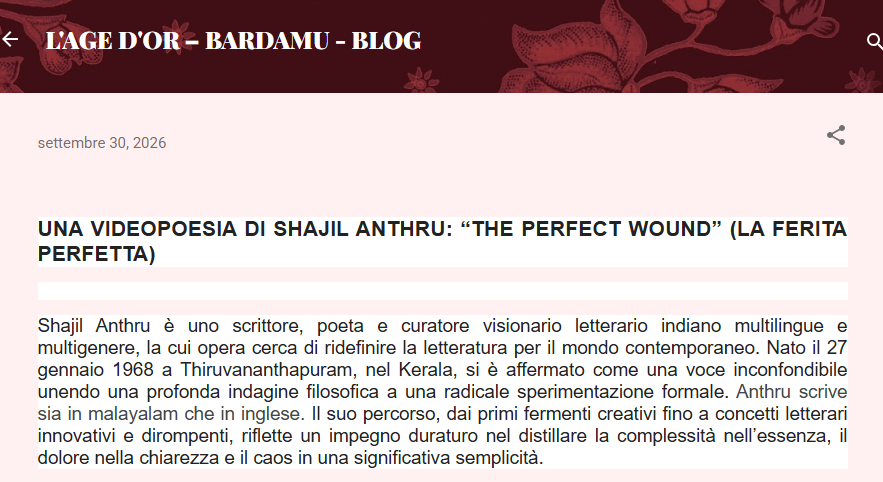
Thiruvananthapuram | 1 October 2026: A poem by Kerala-based poet and writer Shajil Anthru, The Perfect Wound, has found another international literary platform with its presentation as a video poem on the Italian literary blog L’Age d’Or – Bardamu.
The Italian feature, titled “Una videopoesia di Shajil Anthru” (“A video poem by Shajil Anthru”), presents a contemporary poem rooted in Kerala’s cultural imagination to an Italian literary audience.
The significance of the publication lies not merely in the geographical distance between Kerala and Italy, but in the fact that a poem emerging from Kerala’s mythology and cultural memory has entered an Italian literary space while retaining its distinctive identity.
Read the Italian feature:
L’Age d’Or – Bardamu: “Una videopoesia di Shajil Anthru”
L’Age d’Or – Bardamu: An Italian literary and cultural space
L’Age d’Or is an Italian online magazine and cultural-literary platform covering cinema, literature, poetry, theatre, art and contemporary culture. Its published masthead identifies Marco Palladini as Direttore Responsabile (Director) and Désirée Massaroni as Direttore Editoriale (Editorial Director).
Marco Palladini is himself a writer, poet, playwright and cultural commentator whose writings appear extensively through L’Age d’Or. His contributions to the platform include poetry, literary reflections, theatre and cultural criticism.
The literary character of the publication is evident from its range of material, which includes poetry, literature, contemporary art, theatre, cinema, critical essays and cultural commentary. Its archive includes writings by Palladini as well as contributions by numerous other Italian writers and cultural figures.
It is within this Italian literary and cultural environment that The Perfect Wound has appeared.
For a poem originating in Kerala, this represents an interesting instance of literary circulation across cultures.
From Mahabali to an international readership
The Perfect Wound takes one of Kerala’s most enduring cultural figures—Mahabali—and places him in an unusual poetic landscape.
The poem is constructed around Mahabali’s return from the Netherworld during Onam. Instead of presenting Onam only through its familiar associations with celebration, prosperity and the return of a benevolent king, the poem opens a more contemplative space involving memory, justice, exile, return and unresolved loss.
Mahabali addresses an unnamed “you”. The identity of this addressee remains open, allowing the poem to move beyond a straightforward retelling of mythology.
At the centre of the poem stands its defining image: the “perfect wound.”
The wound is not merely an image of suffering. It becomes a larger philosophical question: can remembrance, ritual and celebration compensate for an unresolved wound created by exile, separation and loss?
A critical study of the poem, Mythic Descent and the Ethics of Remembrance: A Critical Reading of “The Perfect Wound”, published in September 2026, examines the poem’s treatment of Onam, Mahabali, descent, memory and justice. The study also reads the three-fold descent in relation to the three steps of Vamana.
When a Kerala myth becomes a universal question
One of the most interesting aspects of The Perfect Wound is that it does not attempt to become “international” by abandoning its Kerala identity.
It does almost the opposite.
It begins with a specifically Kerala cultural memory and raises questions that can be understood far beyond Kerala:
What does it mean to remember?
What does return mean after exile?
Can celebration erase historical pain?
Can time heal the wound of separation?
What remains when memory becomes ritual?
These questions allow the poem to move from the local towards the universal.
The cultural vocabulary belongs to Kerala, but the emotional and philosophical questions belong to human experience.
Mahabali remains Mahabali. Onam remains Onam. Kerala remains present.
Yet exile, remembrance, waiting, loss and return are experiences that do not belong exclusively to any one culture.
This is one of the ways literature travels across borders. A poem does not necessarily become universal by removing its cultural particularity. Sometimes it becomes universal precisely because it speaks from the distinctive experience of a particular place.
From the printed page to visual poetry
The Perfect Wound has also developed beyond the printed page.
Litterateur TV released a visualised reading of the poem under the title Shajil Anthru’s Poetry – The Perfect Wound Visualization. The video presents the poem through a visual interpretation of Mahabali’s voice, descent, memory and unanswered questions.
Watch the visualised poem
Watch “The Perfect Wound” on YouTube
The poem has consequently existed in several forms—as an English literary poem, as visual poetry and as the subject of critical interpretation.
The Italian presentation adds another dimension: international digital literary circulation.
A poem written in India, rooted in Kerala mythology, transformed into visual poetry and subsequently presented through an Italian literary platform demonstrates how contemporary digital culture can create connections between writers and readers separated by geography, language and cultural history.
A poem that invites critical reading
The international appearance of The Perfect Wound comes at a time when the poem has also begun to attract critical attention.
The September 2026 issue of the International Research Journal of Modernization in Engineering Technology and Science (IRJMETS) carries the study “Mythic Descent and the Ethics of Remembrance: A Critical Reading of ‘The Perfect Wound’.”
The study examines the poem’s treatment of Onam, Mahabali, descent, memory and justice, placing the work within a wider literary and comparative framework.
Thus, The Perfect Wound is beginning to occupy several literary spaces simultaneously: poetry, visual expression, critical interpretation and international digital publication.
Why this matters for Kerala literature
For Kerala’s literary community, the Italian appearance is a reminder that international literary circulation is no longer dependent exclusively on conventional publishing houses and printed journals.
Digital literary platforms, independent cultural blogs, online magazines, video poetry and international literary networks have created new pathways through which writing from regional cultures can reach readers elsewhere.
A poem can begin with a local myth, move through an international language, acquire a visual form and eventually appear on a literary platform in another country.
The journey of The Perfect Wound demonstrates precisely such a movement.
It begins with Onam and Mahabali.
It emerges from the cultural memory of Kerala.
It is written in English by a Kerala poet.
It becomes visual poetry.
It becomes the subject of a critical literary study.
And it subsequently appears on an Italian literary platform.
The geographical distance between Kerala and Italy becomes less significant when a poem succeeds in creating a point of human connection.
Shajil Anthru and the international literary conversation
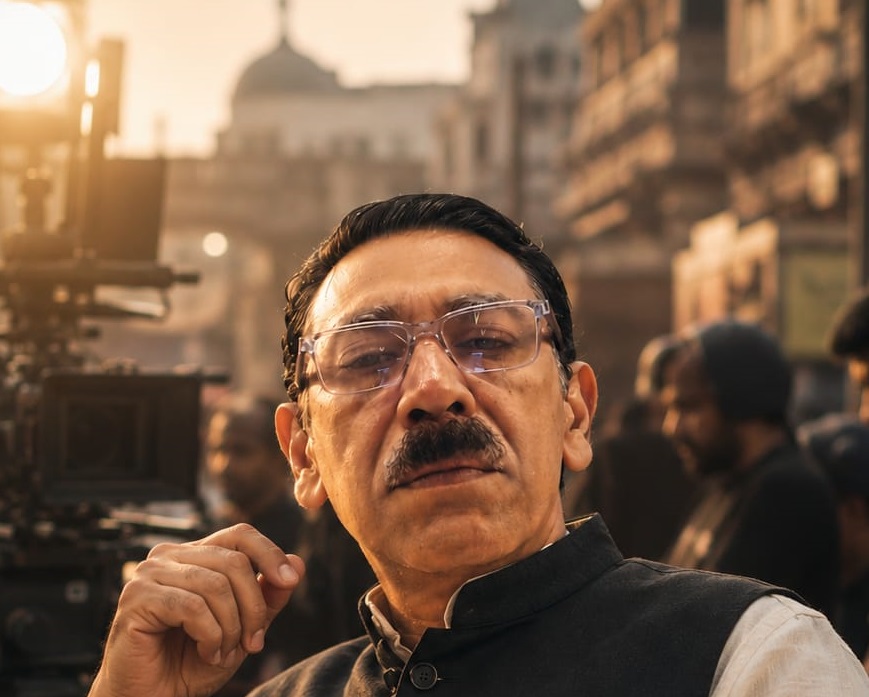
For Shajil Anthru, the Italian appearance adds another dimension to a literary career that has developed across poetry, fiction, criticism, editing and cultural publishing.
Anthru writes in Malayalam and English and is the Founder and Chief Editor of Litterateur Redefining World. His literary and editorial work has focused on bringing different literary cultures, writers and perspectives into conversation.
The appearance of The Perfect Wound in Italy reflects that wider literary movement.
The poem does not travel as an abstract piece of writing detached from its origin. It travels carrying with it Mahabali, Onam, Kerala and the memory of a culture, while simultaneously asking questions that can be encountered by readers elsewhere.
From Kerala to Italy—and beyond
There is a larger significance to such literary encounters.
Kerala has a long and rich literary tradition, but the international circulation of contemporary Kerala writing has often depended upon translation, individual literary initiatives and networks outside the conventional literary establishment.
The digital age is opening additional pathways.
A poem can cross a national boundary almost immediately. A visual interpretation can reach another continent. An independent literary platform can introduce a writer from a distant culture to a new readership.
The appearance of The Perfect Wound on L’Age d’Or – Bardamu is one such moment.
The poem began in the imaginative world of Mahabali’s return. Its movement into an Italian literary space creates another kind of return: a Kerala voice reaching a wider literary world through contemporary digital culture.
Perhaps that is ultimately what makes the journey of The Perfect Wound worth noticing.
A poem does not cease to belong to Kerala when it crosses the border. It carries Kerala with it.
And when Mahabali’s voice is encountered in another literary culture, the wound at the centre of the poem can become not merely a symbol of exile, but also a point of connection between different worlds.
From Kerala to Italy, The Perfect Wound continues its journey.
Related Links
Italian feature:
L’Age d’Or – Bardamu: “Una videopoesia di Shajil Anthru”
YouTube – The Perfect Wound:
Shajil Anthru’s Poetry – The Perfect Wound Visualization
Critical study:
Mythic Descent and the Ethics of Remembrance: A Critical Reading of “The Perfect Wound”
THIRUVANANTHAPURAM: Writer and poet Shajil Anthru’s new English poem, “I Am the President,” has been released, offering a powerful and disturbing satire on political power, war and propaganda.
Written as a first-person dramatic monologue, the poem gives voice to an unnamed president who claims responsibility for war and destruction and ultimately awards himself the “Noble” Prize. Through this dark irony, Anthru examines the psychology of absolute power and the transformation of human suffering into political spectacle.
The poem’s short, direct lines reflect Anthru’s interest in Fishbone Poetry, while its philosophical concerns resonate with his broader literary exploration of power, humanity and Zeroism.
The release video is available on Facebook:
https://www.facebook.com/share/v/1DtJNFM9sW/
Thiruvananthapuram | 3 September 2026
Litterateur TV has released a visualised reading of Shajil Anthru’s English poem “The Perfect Wound.” The film, titled Shajil Anthru’s poetry The Perfect Wound Visualization, runs just under four minutes and is now available on the Litterateur TV channel. The same video is being carried on the Litterateur Online News portal.
The lyric is spoken in the first person from the Netherworld on the returning day of Onam. Mahabali addresses an unnamed “you,” sets remembrance against justice, and ends with the question that gives the poem its title: whether the scheduled feast and the promise of memory are enough. The visualisation places that voice against images of feast, descent, and unanswered space rather than treating the festival only as celebration.
The poem has also been the subject of a published critical reading by the poet himself. The paper, “Mythic Descent and the Ethics of Remembrance: A Critical Reading of ‘The Perfect Wound,’” appears in the International Research Journal of Modernization in Engineering Technology and Science (IRJMETS), Volume 08, Issue 09, September 2026, paper ID IRJMETS80900003593, pages 50–53. The article is online at: https://www.irjmets.com/paperdetail.php?paperId=268e87932b8bd4b15d8200263a0780a9
A publication certificate was issued on 3 September 2026.The study states at the outset that the writer of the poem and the writer of the essay are the same person, and it tries to keep the two roles apart. It reads the lyric as an independent text: calendar time against cosmic time, the three-fold fall as a geological rewriting of Vamana’s three paces, and the last phrase—“the perfect wound”—as a wound that is complete rather than admirable. It also names a limit of the poem, the crowded “you” that may be god, people, or later reader. Comparison is used only to place the architecture of descent, not to claim rank.
Shajil Anthru, Chairman of the K. M. Anthru Foundation and Editor of Litterateur Redefining World, works in Malayalam and English. “The Perfect Wound” belongs to that bilingual line and to a Kerala myth that still returns each Chingam. The new video and the journal essay put the same short lyric in two rooms at once: a public screening and a formal close reading.
Readers may watch the visualisation on Litterateur TV and on this portal, and consult the IRJMETS paper at the link above.
Video: https://www.youtube.com/watch?v=4Irv3c0wAjw
Paper: IRJMETS, Vol. 08, Issue 09, September 2026, ID IRJMETS80900003593
അന്താരാഷ്ട്ര സാഹിത്യമാസികയായ Litterateur Redefining World ന്റെ മലയാളം എഡിഷനായ ലിറ്ററേറ്റർ മാസികയുടെ ആഗസ്റ്റ് 2026 ലക്കത്തിന്റെ മുഖചിത്രം വരച്ചത് റഷ്യയിൽ ജനിച്ച് അമേരിക്കയിൽ ജീവിക്കുന്ന എഴുത്തുകാരിയും കലാകാരിയുമായ നീന കോസ്മാനാണ്. ചിത്രത്തിൽ ഓണപ്പൂക്കളമോ മഹാബലിയോ പതിവ് ഉത്സവചിഹ്നങ്ങളോ ഇല്ല. എന്നിട്ടും അതിൽ കേരളത്തിന് പരിചിതമായ ഒരു വെളിച്ചവും ചൂടും അനുഭവപ്പെടുന്നു.
ചിത്രത്തോടൊപ്പമുള്ള റഷ്യൻ കവിതയ്ക്ക് “ЖАР” (Heat / Fever — ചൂട്, പനി) എന്നാണ് പേര്.
ഓണവുമായി നേരിട്ട് ബന്ധമില്ലാത്ത ഈ കവിതയെയും ചിത്രത്തെയും “ഓണവെളിച്ചം” എന്ന കവിതയിലൂടെ ഷാജിൽ അന്ത്രു പുനർവായന നടത്തുന്നു.
ഒരേ കലാസൃഷ്ടിയെ രണ്ട് വ്യത്യസ്ത സാംസ്കാരിക അനുഭവങ്ങളിലൂടെ വായിക്കാനുള്ള ഈ അവസരം വായനക്കാർക്ക് സവിശേഷമായ അനുഭവമാണ് നൽകുന്നത്.

നീന കോസ്മാന്റെ “ചൂട്” എന്ന ദേശാന്തര അനുഭവത്തിൽനിന്ന് ഷാജിൽ അന്ത്രുവിന്റെ “ഓണവെളിച്ചം” എന്ന കേരളീയ സാംസ്കാരിക പുനർവായനയിലേക്കുള്ള ഈ യാത്ര കേരളത്തിന്റെ ഓണസ്മരണയുമായി ബന്ധിപ്പിക്കുന്നു. പരിചിതമായ ഓണത്തെ അപരിചിതമായ ഒരു കലാഭാഷയിലൂടെ കാണാനുള്ള ഈ സമീപനം വായനയ്ക്ക് പുതിയൊരു ദൃശ്യ-സാംസ്കാരിക അനുഭവം നൽകുന്നു.