Shajil Anthru
Something strange has been happening around the world in recent years: the slow, quiet withdrawal of support for the very platforms that give writers a voice.
Litterateur Redefining World – For Creative Writers is the only international literary magazine published under the KM Anthru Research and Study Centre of the KM Anthru Foundation. For the past five years every piece we have accepted has passed through a rigorous, entirely voluntary peer-review committee. The magazine is free to read on our website—no reading fees, no submission fees, no hidden costs—Just a labor of love for literature. And yet, over these five years we have noticed something painful: most of the writers we have proudly published, writers whose work we have examined and celebrated in depth, have never bought a single copy of the magazine that gave their words an international stage. This is more than disappointing. It feels like a quiet betrayal of everything a literary community is supposed to stand for. The magazine exists because one person had a vision and because reviewers, designers, translators, and editors give their time and skill for free. The KM Anthru Foundation is a non-profit organization. Besides the magazine, in these five years we have trained young people, fed the poor, planted trees, honoured literary talent, and tried—however modestly—to keep some shred of ethics and humanity alive in the world.

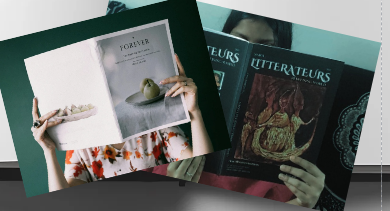
Writers everywhere say they crave serious criticism. We give it to them. Every accepted piece is carefully reviewed by our voluntary committee and published in a proper edition of the magazine—an increasingly rare thing today. When a new issue appears, it is released online as a beautifully designed (and free) PDF, and also as a printed book. Most contributors never download the PDF or order a print copy for their shelf or to give to someone they love. They simply screenshot the pages that contain their own work, post the image with a quick “thank you,” and vanish. We seem to be raising a generation of writers who treat publication not as a window onto a wider world, but as a mirror. There is almost no support for the magazine that fought for their voice. The print edition is sold on Amazon at the lowest price we can manage, just enough royalty to keep the lights on. Even that modest price is apparently too much for most of the writers whose names appear inside. They perform on a stage whose only audience is themselves.
Literature has always needed two kinds of generosity: the generosity to write and the generosity to read. The first is plentiful nowadays; the second is drying up. The indifference runs deeper. How many of our published writers have read, shared, or even mentioned the work of their fellow contributors in the same issue? Almost none.The same writers who demand the world’s attention for their verses on war, race, gender, and climate stay silent about the poems on the same subjects printed a few pages away. It is astonishing. Too many seem to see the space we have built not as a common home for letters, but as a billboard for personal branding. When writers refuse to read one another, they are not merely being rude. They are starving the ecosystem they claim to care about.A creative work does not breathe in isolation; it breathes in conversation. It only finds its true weight beside other works. If we read only ourselves, we end up with a literature that shouts but says nothing, a literature that congratulates itself and goes nowhere.We love to call ourselves changemakers. But what change can we possibly make if all we want is the world’s gaze turned toward us?
This is not mainly an economic crisis. It is a cultural one. The level of our cultural thinking is collapsing. A literature of selfies will never move a society; it will only decorate its surface. Only when we learn to listen—really listen, generously, continually—will we deserve the name “agents of change.” It is time to break the mirror and look out the window again. In many countries where literary magazines actually have readers, a writer’s monthly income would buy two or three cups of coffee with friends. When someone says “I can’t afford the book,” they are usually doing simple arithmetic: “Do I spend this money on something that will feed my body and my friendships for a couple of weeks, or on a book that contains my own work and the work of people I say I respect?” That silence is not always ingratitude. Sometimes it really is just maths. Yet if literature is to survive outside privileged bubbles, we have to face that maths together. A Book for the Price of Lunch. It is time we turned the accessibility of literature into something more than a slogan. If we—who claim to love literature—refuse to read one another, refuse to support one another, refuse to keep alive the few remaining spaces that still believe in collective work, then very soon we will all wake up in chains we never even noticed being forged.
The mirror is cracked. Let’s finally look through the window.