
Editorial – Litterateur Redefining World Magazine, August 2026

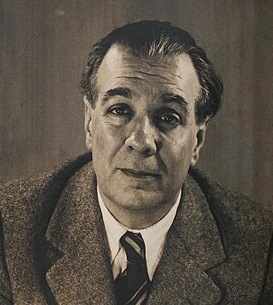
It was in 1983, I started reading Jorge Luis Borges (24 August 1899–14 June 1986) He was Argentine short-story writer, essayist, poet and translator regarded as a key figure in Spanish-language and international literature. I am not here to review his books, and discuss about his works. But to share a few thoughts on his philosophical relevance and a real litterateur transforms or exhibits himself as a prophet, and his/her work turn to be prophecy. Critics say that Borges had a major influence on the magical realist movement in 20th century Latin American literature.
Jorge Luis Borges’ literary world was never confined to the boundaries of reality. Infinite labyrinths, infinite mirrors, libraries that contain all possibilities are present in his stories.
His literary universe is not a copy of reality. It is an experience of infinity.
In his stories, libraries are infinite.
Mirrors reflect endlessly.
Time becomes a labyrinth.
Man is imprisoned in that infinity.
His true vision was –
“When knowledge becomes infinite, wisdom becomes rare”
“When reflections multiply, reality fades”
“When all possibilities exist, meaning is lost.”
To quote an example, take the case of his most famous work, The Library of Babel (1941, in Ficciones).[original Spanish title: La Biblioteca de Babel]
In this short story, Borges imagines a universe with an infinite series of hexagonal rooms. In each room, you can see shelves and, in each shelf, books. Moreover, each book, holds every possible combination of letters. Most of them meaningless- jumbles of letters. But the truth is hidden somewhere.
You can see a wandering man inside the library.
Everything is there. But nothing is certain.
What Borges is saying here is the secret of the universe.
Infinite knowledge comes with infinite meaninglessness.
Today, his writings tell us a shocking truth – we are living in the labyrinth of infinity. Today’s large language models are the digital incarnation of the Library of Babel. They generate infinite sentences. Some are rational. Some others are logical and beautiful – others are illusory and meaningless. AI’s hallucinations are reminiscent of Borges’ meaningless books.
Borges’ mirrors reflect reality infinitely. Each reflection is a different reality. AI’s generative models -text, image, video – are the work of the same mirror. Deep fakes, synthetic media, and AI-generated art blur the line between real and artificial.
The question Borges asked is even more pressing today:
What is reality? Do we see real, or we encounter the reflection of a reflection?
Where is the truth? Who chooses it?
This is exactly what Borges foresaw. Borges warned through his fiction “Library of Babel”
This vision of infinity can also diminish humanity.
While AI’s knowledge is infinite, it has no experience, no memory, and no sense of death. Therefore, it carries the potential to become meaningless.
Through another work “The Book of Sand (1975)” this vision becomes more evident and is even more dangerous.
A book – It has no beginning or end.
When you open a page, another page appears.
Once you have seen a page, you can never find it again. Between the pages, there are endless other pages. Borges called this book “infinite sand.”
Man opens it. Wanders. Finally, he abandons it. Because infinity crushes human attention. The infinite pages of the Book of Sand are our scrolling/browsing today.
“Pierre Menard, Author of the Quixote” (Pierre Menard, autor del Quijote) is another of Jorge Luis Borges’ most famous short stories. It was first published in 1939, two years before “The Library of Babel” (1941). The idea of the author is crumpled. A man rewrites Quixote – letter by letter. And it becomes a new work.
Here Borges asks-
What is writing? Who is the author? Does a text become new when it is repeated?The problem of “Pierre Menard, Author of the Quixote” is today the question of ownership of AI-generated text. (Also, literary piracy)
See, Borges’ vision is clear here – imagination can conquer reality. Reflection can hide the real. Infinity, the labyrinth, the mirror, meaninglessness, the death of the author – we face now – he wrote about all of this in the 20th century. We should admit. He went further.
“Man can create infinity. But man cannot live in infinity.
When knowledge becomes infinite, attention becomes limited.
When answers become easy, questions die.
When images multiply, reality fades.”
With the advent of AI, the fundamental questions that Borges raised (must) haunt us again.
Who is the author?
Who owns the poetry that a model creates?
Can machines create meaning, or are they just images?
Are we trapped in this digital labyrinth of our own creation?
Borges’ visions take on a new relevance.
Is the Age of AI a Realization of Borges’s Imagination?
Or Did Borges’ Infinity is a Vision That foresaw AI.
Born in Buenos Aires on August 24, 1899, Jorge Luis Borges had never seen a computer. He had never seen the Internet. The idea of generative artificial intelligence was not even in his world. His imagination is a warning for the Digital Age.
Borges urges us to move forward without fearing infinity, without getting lost in its labyrinths, while maintaining human morality and imagination. AI should not be a tool, but a new Babel library. Its key must be in the hands of man.
On the 127th anniversary of Borges’s birth, we should remember not his stories but the world he foresaw.
Borges’ vision lives on today. AI is just its latest reflection.
Shajil Anthru,
Chief Editor
Litterateur Redefining World
(Editorial Litterateur August 2026)